

Blast Chiller Buyers Guide 2026
The Complete Commercial Blast Chiller Buyer's Guide 2026
Master HACCP compliance equipment with real auction data from 129 sales. Compare Alto Shaam, Traulsen, Desmon, and Randell units, understand chilling modes, avoid inspection red flags, and stop gambling with food safety. Expert guidance from America's premier restaurant equipment auction house.
The Equipment Nobody Wants Until They Need It
No chef has ever gotten excited about a blast chiller. No menu item exists because of one. No customer chooses a restaurant based on its rapid cooling capabilities. The blast chiller sits in the corner of the kitchen, unglamorous and overlooked, doing nothing that creates Instagram-worthy moments or generates buzz.
And yet, this single piece of equipment separates operations running legitimate food safety programs from those rolling the dice every single day.
The problem is simple: hot food needs to become cold food quickly. The FDA Food Code requires cooling cooked foods from 135°F to 70°F within two hours, then from 70°F to 41°F within an additional four hours. Six hours total from cooking temperature to safe storage temperature. Miss that window, and the food must be discarded. Miss that window unknowingly, and pathogens multiply to dangerous levels while the food gets served to customers.
Alto-Shaam QC2-40 blast chiller - the professional solution to HACCP cooling requirements
Most kitchens know these rules exist. Most kitchens ignore them through band-aid solutions that technically violate food safety protocols while appearing to work. The soup gets divided into shallow pans. The roast sits on the counter to "cool down" before refrigeration. The stock pot goes into the walk-in while still steaming. Someone plunges a frozen "cooling stick" into the chili and calls it handled.
These methods share a common flaw: they rely on assumptions rather than verification. Did the soup in those shallow pans actually reach 41°F within six hours? Did the roast cool uniformly, or did the center remain in the danger zone while the surface temperature dropped? Did that steaming stock pot raise the temperature of everything else in the walk-in, potentially compromising items that were already safely stored?
The blast chiller eliminates assumptions. It pulls food temperature down rapidly and uniformly, with probe verification confirming internal temperatures throughout the process. What takes six anxious hours using improvisational methods takes 90 minutes in a blast chiller with documented proof that food safety requirements were met.
The True Cost of "Good Enough" Cooling
Let's talk about what happens when assumptions fail.
A single dish improperly cooled and served to a customer who gets sick creates immediate problems: health department investigation, potential lawsuit, staff retraining requirements, operational review. These situations are recoverable. They're expensive and embarrassing, but businesses survive them with proper response protocols.
Consider the math. A foodborne illness outbreak traced to improper cooling procedures can result in legal exposure exceeding six figures per affected customer. Lost revenue during investigation and remediation. Permanent reputation damage in an era where negative reviews spread instantly. Potential criminal liability for management if negligence is established. Insurance premium increases that persist for years.
Now consider the alternative. A functional blast chiller from auction costs $500-$1,500 for most operations. The Randell BC-18—a full-sized commercial unit capable of handling serious volume—regularly sells for $140-$230 at auction. That's the price of a few cases of premium beef or a single slow Saturday night. The math writes itself.
Beyond liability reduction, blast chillers deliver operational benefits that compound over time. Batch cooking becomes genuinely practical rather than anxiety-inducing. Prep-ahead workflows expand because rapid cooling enables safe make-ahead production. Quality improves because proper rapid cooling preserves texture and flavor better than slow ambient cooling. Staff confidence increases because they're following documented procedures rather than hoping improvised methods worked.
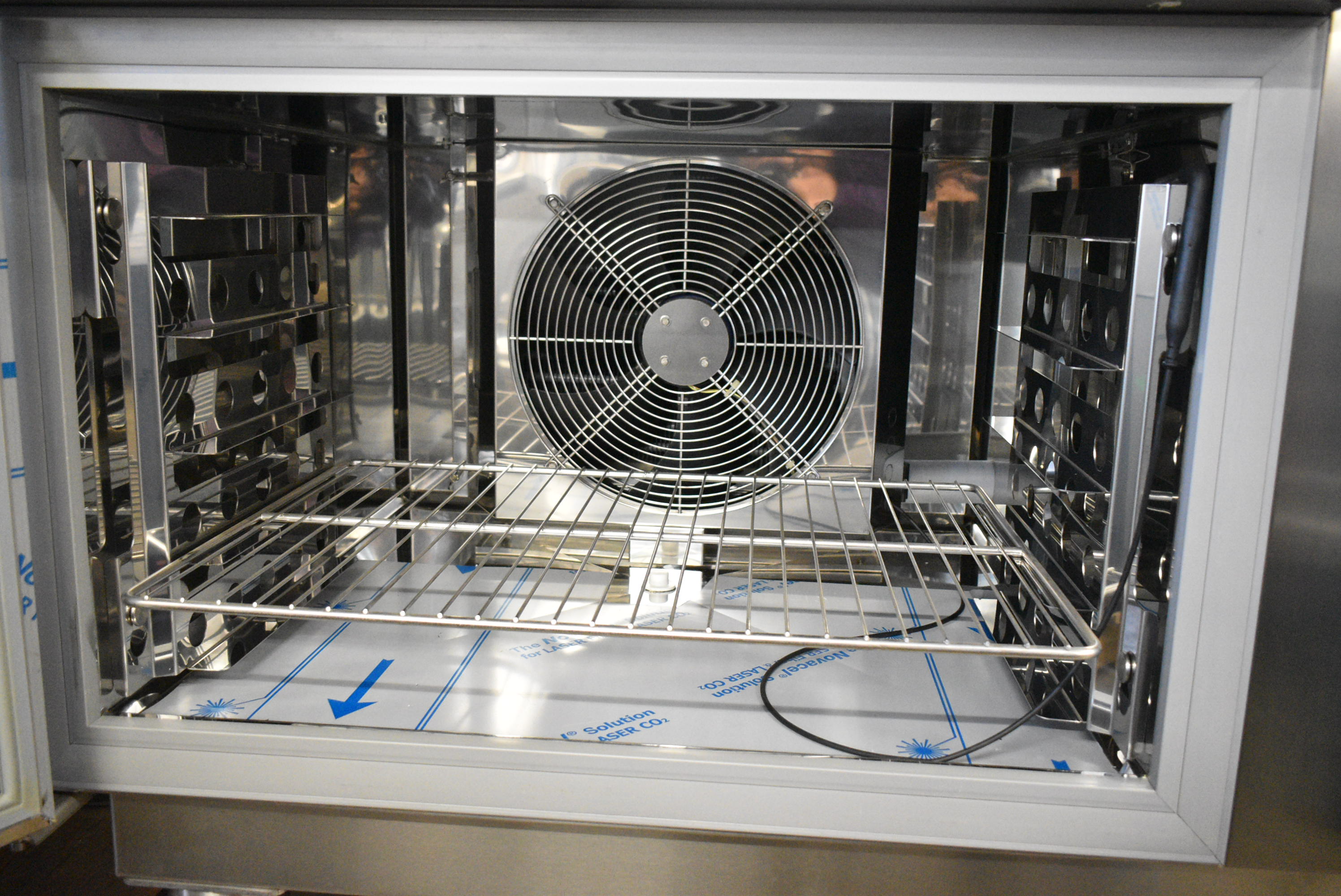
Brand new blast chiller interior - the professional infrastructure for food safety compliance
Understanding Blast Chiller Technology
Blast chillers accomplish rapid cooling through high-velocity refrigerated air circulation. Unlike standard refrigerators that rely on passive cold air settling around products, blast chillers actively force cold air across food surfaces at high speeds. This aggressive air movement breaks through the warm boundary layer that naturally forms around hot items, dramatically accelerating heat transfer.
The technology is straightforward refrigeration applied with intensity. Compressors, evaporators, and fans work together to create an environment where heat extraction happens quickly and uniformly. The "blast" in blast chiller refers to this forced-air approach—cold air blasting across products rather than gently surrounding them.
Capacity Ratings: Pans vs. Pounds
Manufacturers rate blast chiller capacity using two metrics: pan capacity and pound capacity. Both matter for different reasons.
Pan capacity indicates how many standard 2-inch hotel pans fit in the unit simultaneously. A 5-pan blast chiller holds five pans; a 15-pan unit holds fifteen. This metric helps with workflow planning—how much product can cycle through the unit during a prep shift.
Pound capacity indicates the maximum weight of product that can be effectively chilled from 160°F to 38°F within 90 minutes (the industry standard benchmark). This metric reflects actual cooling performance. A unit might physically hold fifteen pans, but if loaded beyond its pound capacity, cooling times extend past the 90-minute target.
Chilling Modes: Soft, Hard, and Shock
Commercial blast chillers offer multiple chilling modes optimized for different product types. Understanding these modes enables proper equipment operation and optimal results.
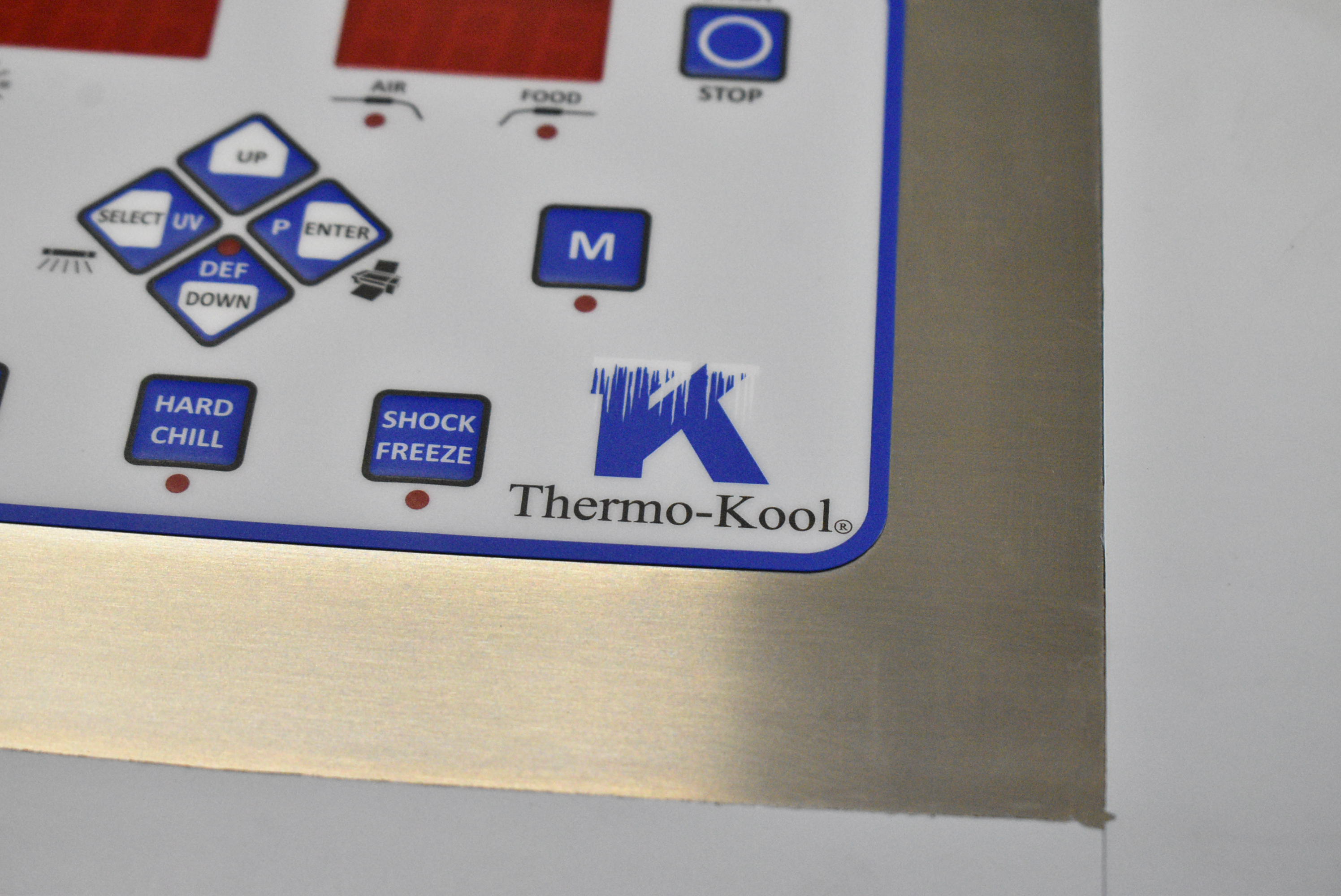
Control panel displaying the three primary chilling modes - soft chill, hard chill, and shock freeze
Soft Chill: Gentle temperature reduction designed for delicate or loose foods. Grains, rice preparations, sautéed vegetables, and items where aggressive air movement might cause drying or texture damage. The fan speed reduces compared to harder modes, extending cycle time but protecting product quality. Temperature targets typically reach 37-40°F.
Hard Chill: Aggressive cooling for dense products that resist heat transfer. Roasts, braised meats, thick sauces, casseroles—items where the center remains hot long after surfaces cool. Maximum fan speed and lowest achievable temperatures force rapid heat extraction. This mode handles the challenging cooling scenarios where improvisational methods most often fail.
Shock Freeze: Rapid temperature reduction targeting frozen storage rather than refrigerated storage. The unit drives product temperature below freezing quickly, enabling immediate transfer to frozen inventory. Ideal for prep-ahead items destined for freezer storage, portioned proteins, or any product intended for future thawing and service rather than immediate refrigerated holding.
Probe Systems: Verification Not Assumption
Probes distinguish professional blast chilling from expensive guesswork. These temperature sensors insert into product cores, measuring actual internal temperatures rather than inferring them from surface conditions or cycle times.

Probe assembly for core temperature verification - essential for HACCP documentation
Surface temperature deceives. A roast may feel cold to the touch while its center remains dangerously warm. Dense foods like lasagna or thick soups can present refrigerator-cold surfaces while interior sections haven't yet left the danger zone. Probes eliminate this uncertainty by measuring what actually matters: the slowest-cooling point of the product.
Most commercial blast chillers include 3-4 probes, enabling simultaneous monitoring of multiple products or multiple points within a single large item. The unit cycles based on probe readings rather than arbitrary timers—cooling continues until probes confirm target temperatures are achieved throughout the load.
This probe-based operation creates automatic HACCP documentation. The unit records temperature data throughout the cycle, generating evidence that proper cooling procedures were followed. When the health inspector asks how you verify cooling compliance, the answer is printed on a receipt rather than defended through verbal explanation of methods that may or may not have worked.
Equipment Configurations
Blast chillers come in three primary configurations, each suited to different operational scales and kitchen layouts.
Undercounter Blast Chillers
Compact units fitting beneath standard countertops, similar in footprint to undercounter refrigerators or dishwashers. These units typically accommodate 3-5 pans and handle 30-50 pounds per cycle. The small footprint enables installation in space-constrained kitchens without dedicated blast chiller stations.
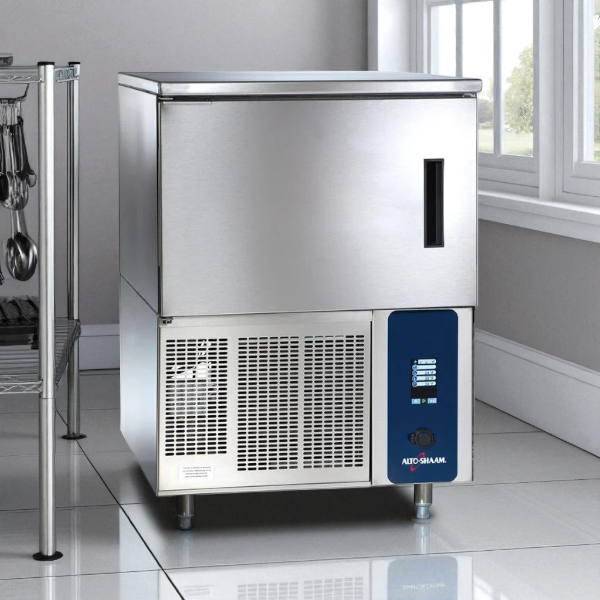
Alto-Shaam QC3-3 undercounter blast chiller - compact HACCP compliance for smaller operations
Undercounter models excel in cafes, small restaurants, catering operations, and any kitchen where batch production exists but volume doesn't justify floor-standing equipment. They're also popular as dedicated stations in larger kitchens—a sauce station with its own undercounter blast chiller, for example, enabling workflow without competing for shared equipment access.
Our auction data shows 13 undercounter units sold with $355 median pricing. The range spans $200-$3,350, with premium pricing reflecting brand-new Alto-Shaam QC3-3 units that retail over $8,000.
Reach-In Blast Chillers
Floor-standing units resembling single-door or double-door reach-in refrigerators. These represent the workhorse category for most commercial operations, handling 10-20 pans and 80-200+ pounds per cycle depending on model. The reach-in configuration provides substantial capacity while maintaining reasonable footprint requirements.
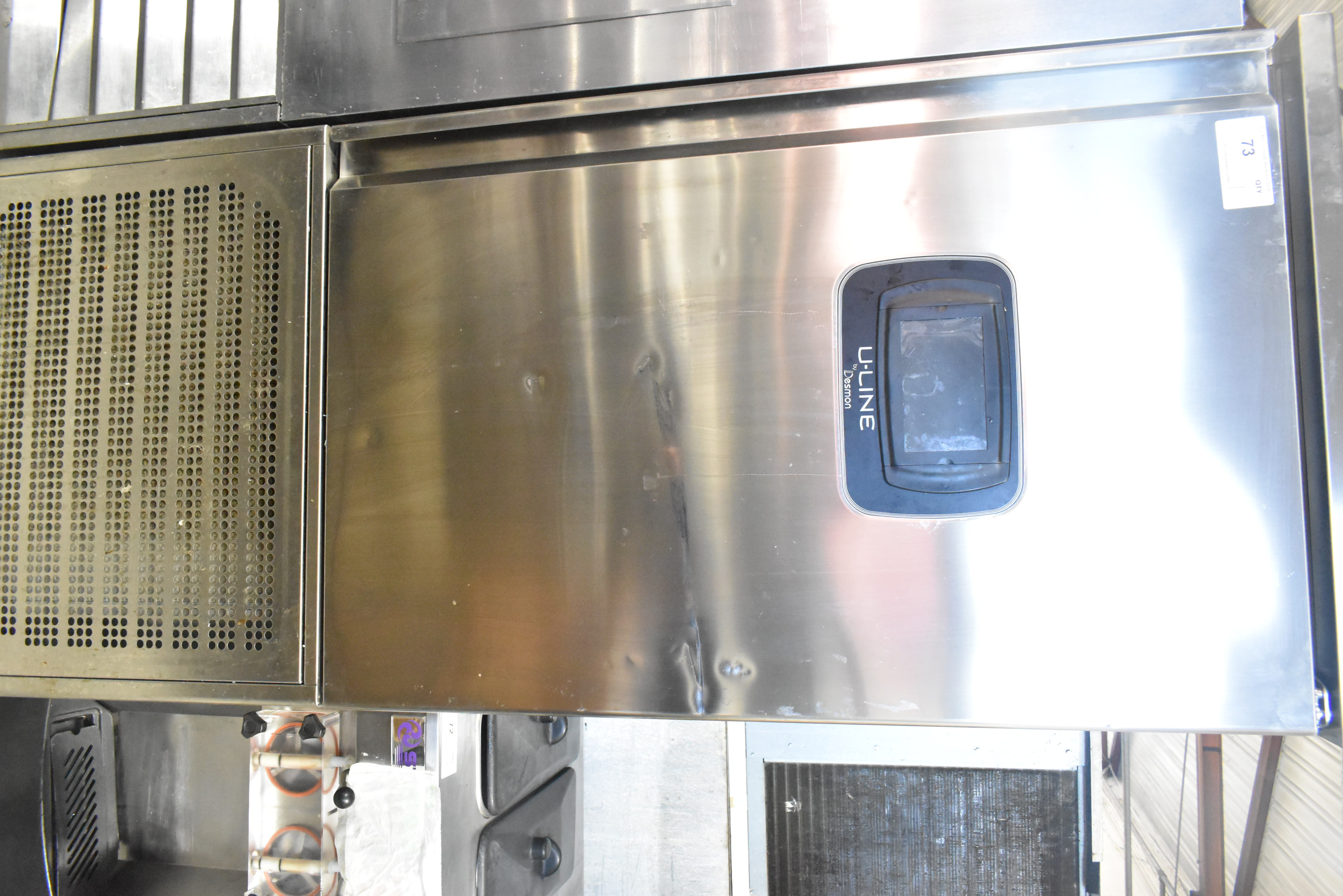
Desmon GBF-15+ETL reach-in blast chiller - the workhorse configuration for commercial kitchens
Reach-in blast chillers dominate our auction inventory with 113 units sold and $625 median pricing. This configuration serves restaurants, institutional kitchens, catering operations, food production facilities, and any operation producing batch-cooked items requiring rapid cooling. The price range of $104-$9,750 reflects everything from well-used Randell budget units to brand-new Alto-Shaam premium equipment.
Roll-In Blast Chillers
Large-capacity units accepting full sheet pan racks that roll directly into the chamber. These handle 40-100+ pans and 300-500+ pounds per cycle, serving institutional-scale operations where smaller units would create workflow bottlenecks.

Alto Shaam QC3-100R roll-in blast chiller with remote compressor - institutional-scale cooling capacity
Roll-in configurations appear infrequently at auction—only 3 units over our analysis period—but command premium pricing with $1,025 median and ceiling approaching $9,000 for brand-new crated units. Hospital kitchens, university dining services, large catering commissaries, and food production facilities represent typical roll-in users. The format enables efficient integration with existing rack-based workflows: load a rack during production, roll it into the blast chiller, roll it into walk-in storage after cycling completes.
Self-Contained vs. Remote Refrigeration
Most blast chillers use self-contained refrigeration systems—compressor, condenser, and evaporator housed within the unit itself. This simplifies installation (only electrical and drainage connections required) but generates heat within the kitchen space and creates noise from compressor operation.

Remote compressor system - moves heat and noise outside the kitchen environment
Remote refrigeration systems locate the compressor and condenser outside the kitchen, typically on rooftops or in mechanical rooms. Refrigerant lines connect the external system to the blast chiller's evaporator. This configuration reduces kitchen heat load, eliminates compressor noise from the work environment, and often improves energy efficiency through better heat rejection.
The tradeoff: remote systems cost more to install (refrigerant line runs, external equipment mounting) and create additional maintenance access requirements. For auction buyers, remote units require confirming that the external compressor is included with the purchase or budgeting for replacement compressor installation.
Market Reality: 129 Sales Analyzed
Analysis of 129 commercial blast chiller sales over approximately 21 months reveals pricing patterns, brand performance data, and condition distributions unavailable elsewhere. This dataset captures the secondary market reality that auction buyers actually encounter.
- Median sale price: $625
- Mean sale price: $1,116 (elevated by premium units)
- Price range: $104 to $9,750
- 25th percentile: $230
- 75th percentile: $1,500
The $625 median represents typical auction outcomes—functional used equipment from closed operations or manufacturer overstock with various condition levels. The substantial gap between median ($625) and mean ($1,116) reflects the influence of brand-new in-crate units and premium configurations selling in the $3,000-$9,750 range.
Price Distribution by Configuration
| Configuration | Units Sold | Median Price | Price Range |
|---|---|---|---|
| Undercounter | 13 | $355 | $200 - $3,350 |
| Reach-In | 113 | $625 | $104 - $9,750 |
| Roll-In | 3 | $1,025 | $905 - $9,000 |
Reach-in units dominate auction volume (88% of sales) because they serve the broadest range of operations. The undercounter tier provides entry-level access to blast chilling capability at accessible price points. Roll-in units appear rarely, reflecting their specialized institutional applications and limited secondary market circulation.
Condition Split: New vs. Used
Unlike many equipment categories where used units dominate auction inventory, blast chillers show substantial brand-new availability through manufacturer overstock and scratch-and-dent channels.
| Condition | Units Sold | % of Market | Median Price | Price Range |
|---|---|---|---|---|
| Brand New (BNSD/BNIB) | 32 | 25% | $1,550 | $210 - $9,750 |
| Used | 97 | 75% | $500 | $104 - $3,100 |
The 3.1x price premium for new equipment ($1,550 vs. $500 median) reflects genuine value differences: full functionality guarantee, unused components, and substantially longer expected service life. For operations where equipment reliability directly impacts food safety compliance, the new-condition premium often justifies itself through reduced risk and maintenance requirements.
Brand Hierarchy: The Numbers Tell the Story
Brand performance varies significantly in the blast chiller market, with clear tiers emerging from auction pricing data. Understanding these tiers helps calibrate expectations and bidding strategy.
| Brand | Units Sold | Median Price | Price Range | Tier |
|---|---|---|---|---|
| Desmon | 35 | $1,500 | $211 - $4,999 | Premium |
| Traulsen | 13 | $1,025 | $225 - $2,050 | Premium |
| Thermo-Kool | 18 | $1,000 | $450 - $1,650 | Premium |
| Alto Shaam | 22 | $840 | $130 - $9,750 | Premium |
| Randell | 39 | $210 | $104 - $2,805 | Budget |
| Piper | 8 | $196 | $105 - $290 | Budget |
Premium Tier: Desmon, Traulsen, Thermo-Kool, Alto Shaam
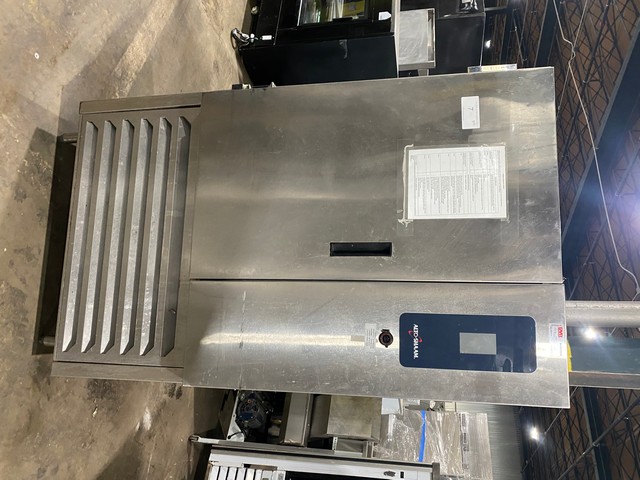
Alto Shaam represents the gold standard in commercial blast chilling. Their QuikChiller line—models like the QC2-40, QC3-3, and QC3-100—delivers exceptional build quality, intuitive controls, and reliable performance that justifies premium positioning. The wide price range ($130-$9,750) reflects everything from older used units to brand-new-in-crate roll-in systems with remote compressors.
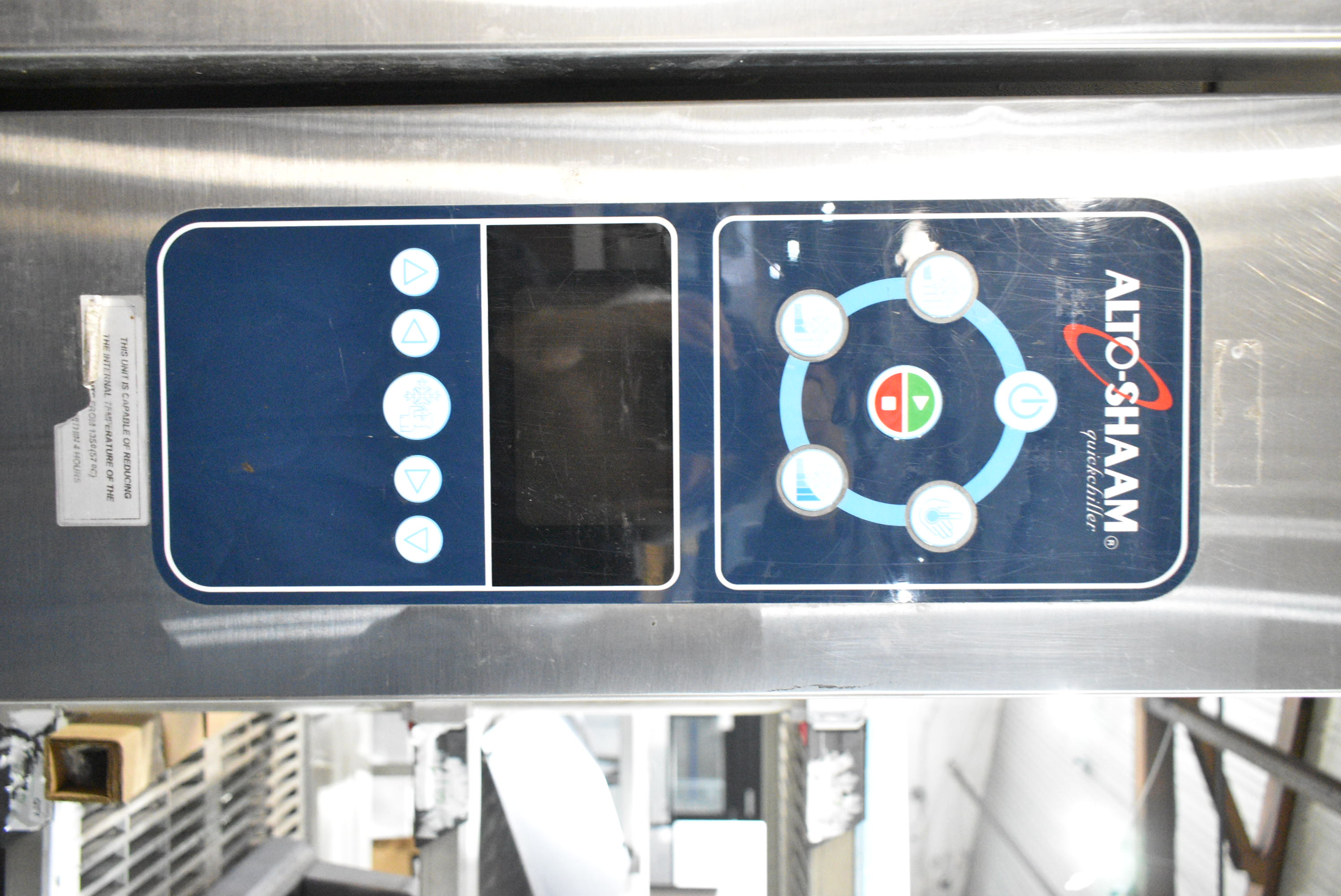
Alto-Shaam digital control panel - intuitive interface with comprehensive cycle programming
Desmon appears frequently in our inventory through scratch-and-dent and overstock channels. The GBF-15+ETL model dominates, offering solid performance at price points below comparable Alto Shaam units. Italian manufacturing with ETL certification for North American markets. The $1,500 median reflects substantial BNSD availability rather than purely used-market pricing.
Traulsen brings institutional-grade construction to the blast chiller category. Known primarily for their refrigeration products, Traulsen blast chillers deliver the same heavy-duty build quality expected from the brand. The TBC13 reach-in appears regularly in auction inventory with pricing reflecting strong secondary market demand.
Thermo-Kool units appeared in significant volume through manufacturer overstock during our analysis period. The multi-compartment configurations (2-door and 4-door models) offer interesting operational flexibility—multiple independent chambers enable simultaneous cooling of different products without cross-contamination concerns.
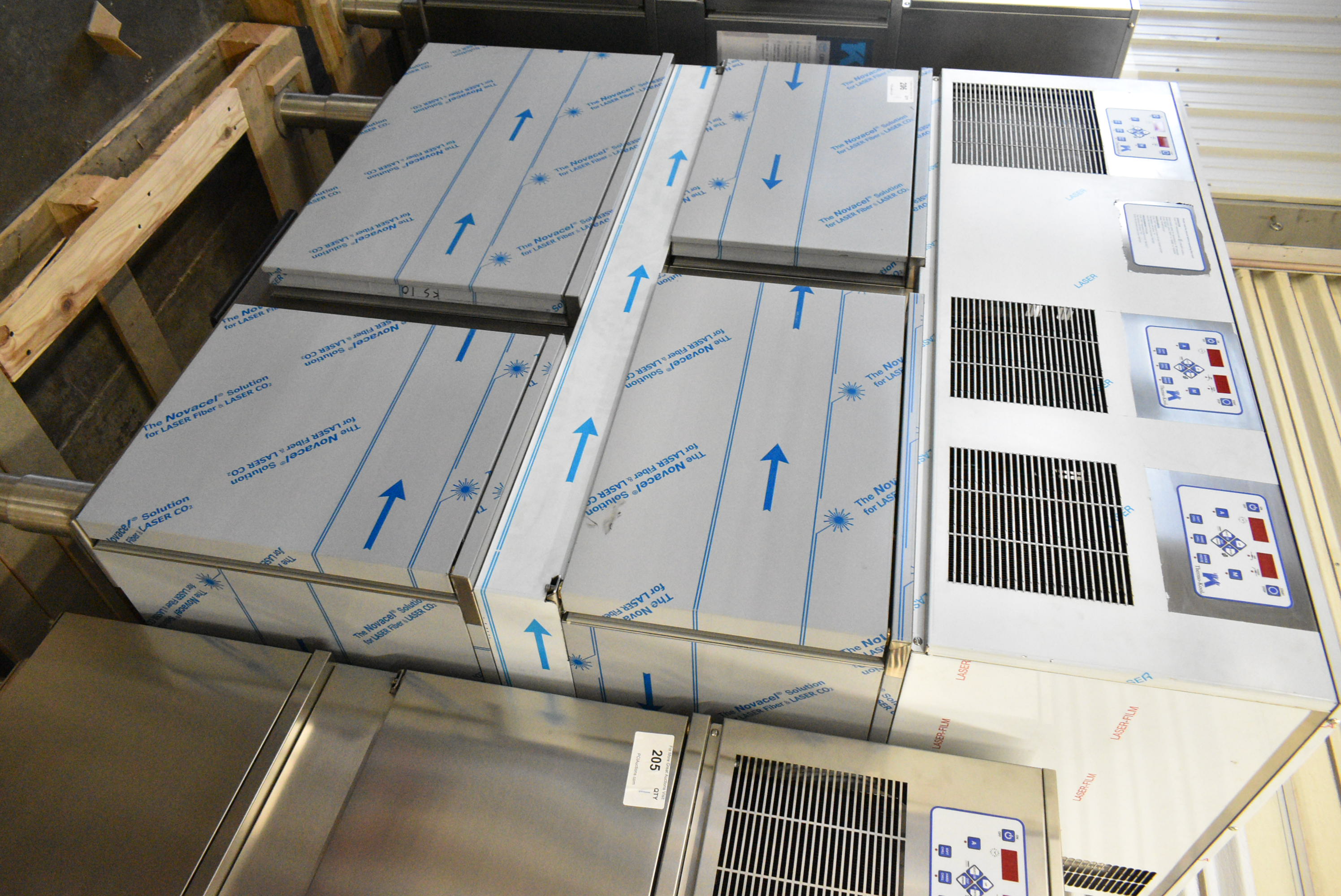
Thermo-Kool 4-compartment blast chiller - independent chambers for simultaneous multi-product cooling
Budget Tier: Randell and Piper
Randell dominates auction volume with 39 units sold—more than any other brand. The BC-18 model appears consistently, serving as the entry-level path to HACCP compliance for smaller operations. These full-sized commercial units handle serious volume while selling at price points that make food safety equipment genuinely accessible.
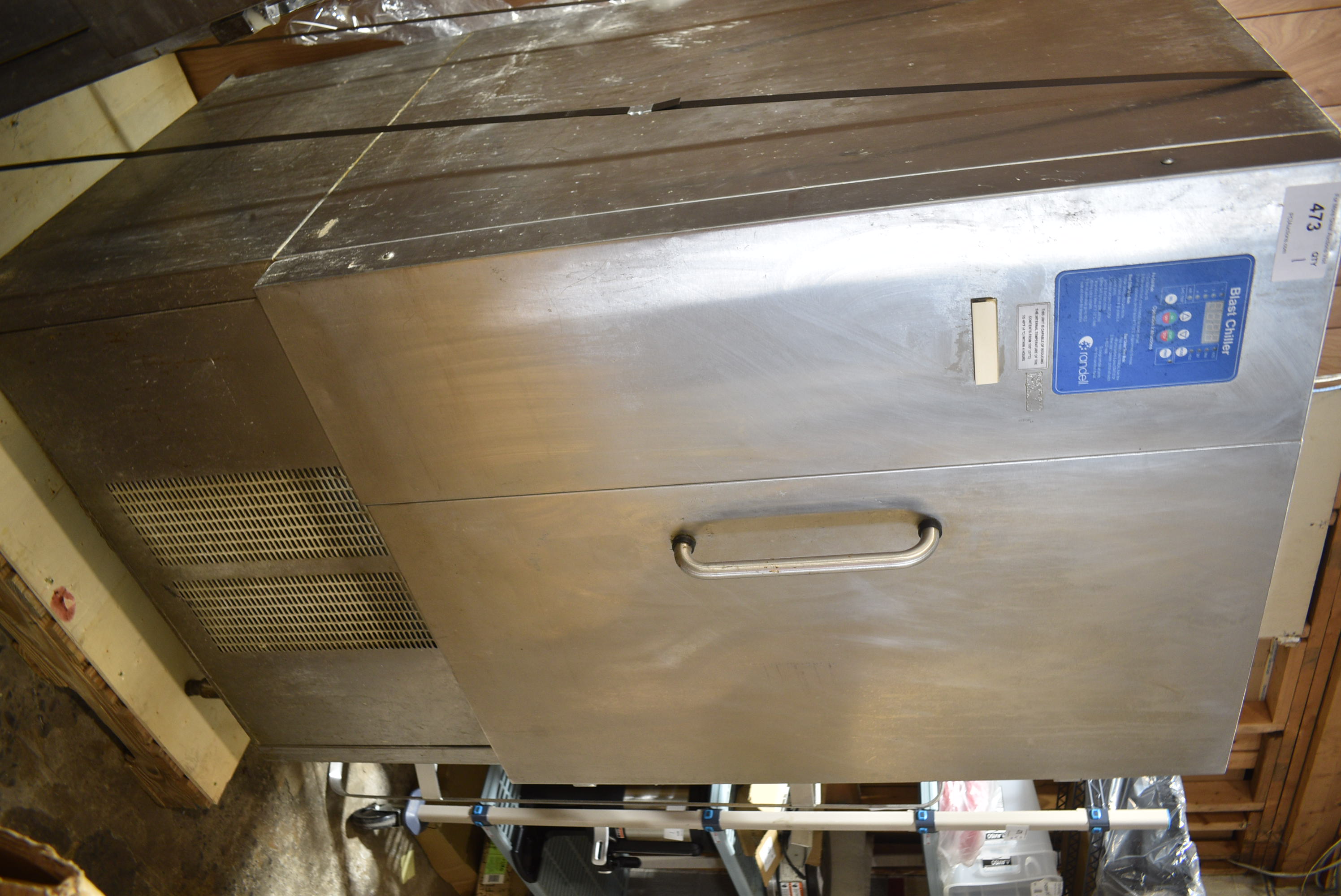
Randell BC-18 - the budget workhorse bringing HACCP compliance within reach at $140-$230
The $210 median price point deserves emphasis. A functional commercial blast chiller—not a compromised consumer unit, but actual commercial equipment capable of meeting food safety requirements—selling for roughly the cost of a single case of premium beef. For operations that have been gambling with improvisational cooling methods, the Randell BC-18 eliminates excuses.
Condition varies significantly in the Randell secondary market. Many units come from quick-service chains and cafeteria operations (grocery store prepared food sections are common sources) where equipment sees heavy use. Careful inspection becomes essential, but well-maintained examples deliver legitimate value.
Piper Products represents the lowest price tier with $196 median. These units work adequately but lack the build quality and feature sets of premium brands. For operations with tight budgets and moderate cooling requirements, Piper provides functional capability. For operations expecting years of reliable service under demanding conditions, the premium tier offers better long-term value.
Brand Selection Reality
All major brands—Alto Shaam, Traulsen, Desmon, Thermo-Kool, Randell, Piper—use similar core refrigeration technology. The differences lie in build quality, control sophistication, service network accessibility, and expected longevity. Premium brands deliver more consistent performance over longer timeframes. Budget brands provide functional capability at lower entry costs.
For operations where blast chilling is mission-critical (high-volume batch production, catering commissaries, institutional kitchens), premium brands justify their cost through reliability and durability. For operations adding blast chilling capability for the first time with moderate volume requirements, budget brands provide genuine value.
Critical Inspection Points
Commercial blast chillers sold at auction typically cannot be powered during preview. Most units require 208-240V electrical service unavailable at auction preview facilities. Visual inspection becomes the primary evaluation tool, supplemented by understanding what visible conditions indicate about underlying equipment health.
Probe Presence and Condition
Probes represent the most commonly missing component on used blast chillers. Check immediately: are probes present? How many? What condition are the cables and connectors in?
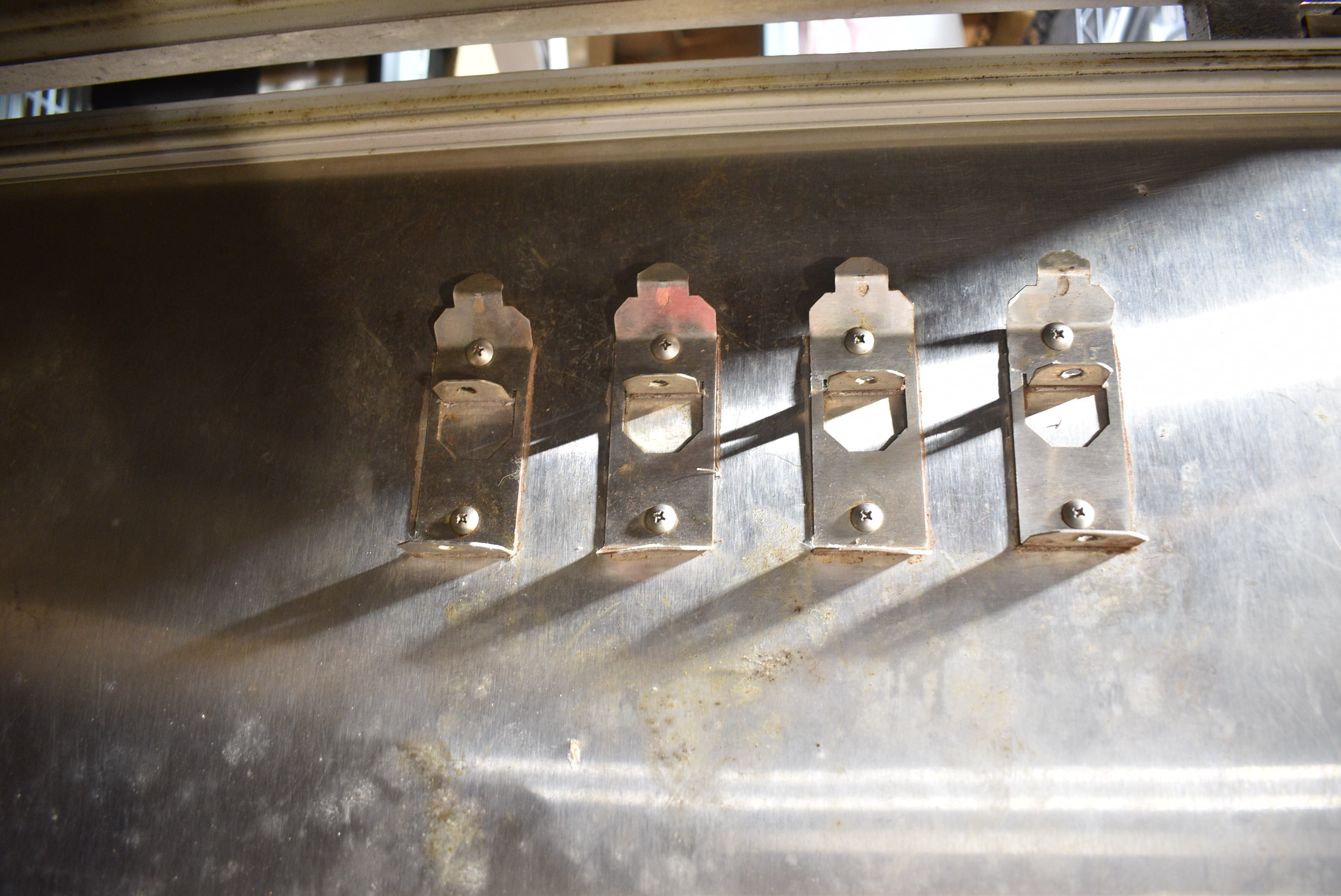
Missing probes - a common condition requiring replacement before unit provides full functionality
Missing probes don't render a blast chiller useless—units still cool products effectively. But without probes, the unit cannot verify core temperatures, which defeats the HACCP documentation purpose that justifies the equipment purchase. Replacement probes cost $50-$150 each depending on brand and model. Factor this into bidding if probes are absent.
Probe cables deserve inspection even when probes are present. Look for cuts, kinks, exposed wiring, or connector damage. Cables experience stress from repeated insertion and removal; worn cables may read intermittently or fail entirely.
Interior Cavity Condition
The interior tells the equipment's life story. Clean, undamaged interiors suggest operators who maintained their equipment properly. If they invested effort in regular cleaning, they likely followed maintenance protocols for compressors, condensers, and refrigeration systems.
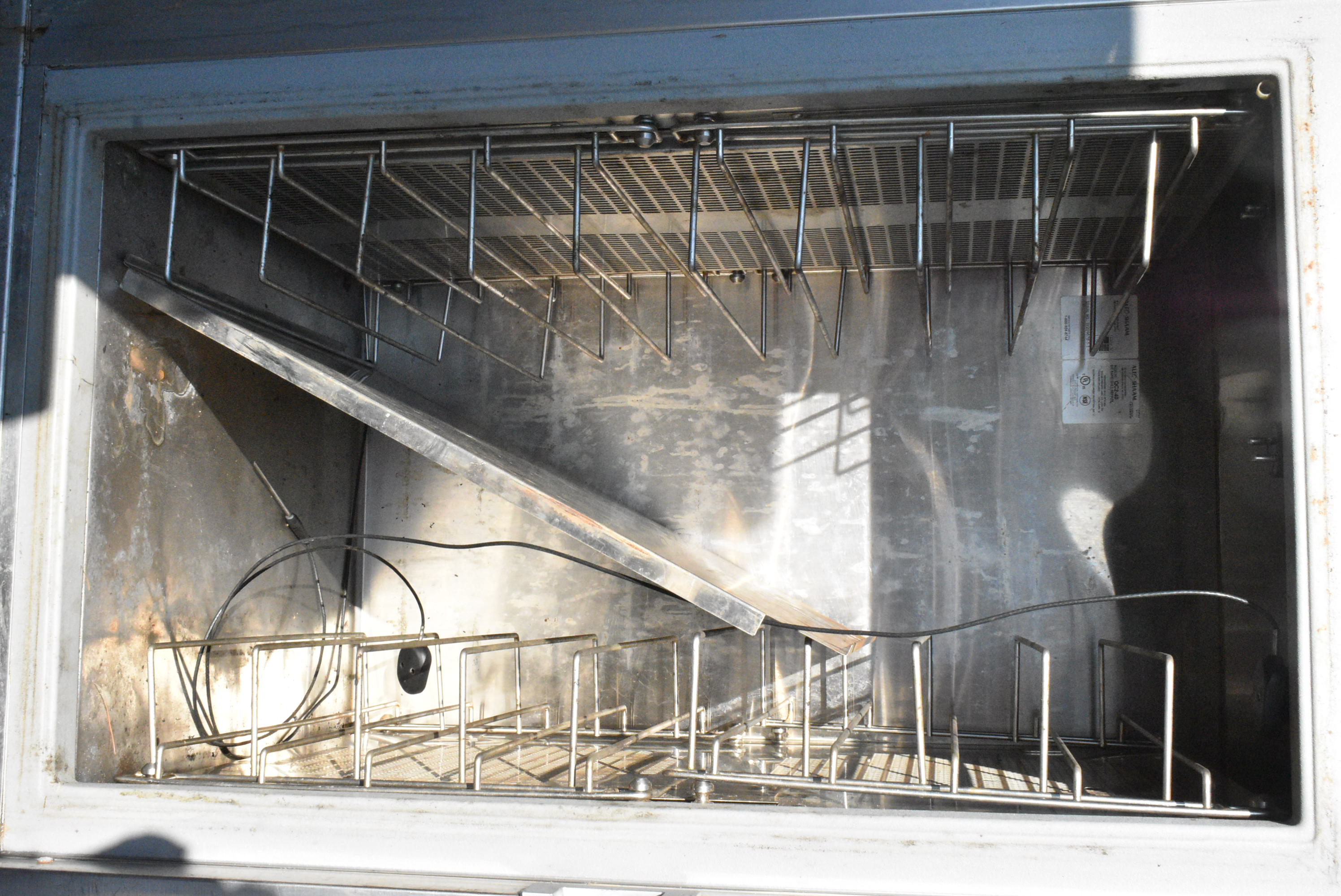
Used interior showing wear but maintaining serviceable condition - typical of working equipment
Look for rust or corrosion, particularly around drain areas and lower sections where moisture accumulates. Surface discoloration from cleaning chemicals is normal; structural corrosion affecting metal integrity is problematic. Check rack slides for smooth operation—bent or damaged slides make pan loading and unloading difficult.
Examine door gaskets for compression, tears, or degradation. Gaskets that don't seal properly allow cold air escape, extending cycle times and reducing cooling effectiveness. Replacement gaskets typically cost $100-$300 depending on door size and brand.
Compressor and Refrigeration System
For self-contained units, the compressor compartment is typically accessible from the rear. While powered testing isn't possible at preview, visual inspection reveals important information.
Look for oil stains around compressor fittings—these may indicate refrigerant leaks. Check refrigerant lines for damage, kinks, or obvious repairs. Examine the condenser coil for debris accumulation that would impair heat rejection. Heavy dust or grease coating on condenser fins suggests deferred maintenance that may extend to other systems.
Control Panel Assessment
Without power, control panel assessment is limited to physical condition evaluation. Check for cracked displays, missing buttons, visible water damage, or evidence of electrical problems (burn marks, melted components). Digital control boards on premium brands cost $500-$1,500 to replace—factor this into bidding if damage is evident.
Mechanical controls on older units are generally more durable and less expensive to repair. The simplicity of analog timers and thermostats versus digital controllers creates a reliability advantage for basic models.
Specification Plate: Critical Information
Every commercial blast chiller has a specification plate listing electrical requirements, capacity ratings, and model information. This plate provides essential data for installation planning.

Specification plate showing electrical requirements - verify compatibility before bidding
Verify voltage and phase requirements match your facility capabilities. Many blast chillers require 208-240V service; some larger units need three-phase power. Units listed as 220V 3-phase (common on Desmon models) require three-phase electrical infrastructure. If your facility has only single-phase service, budget for conversion or infrastructure upgrade costs.
Record model numbers for parts research. If post-purchase service is needed, having exact model identification enables accurate parts ordering and service scheduling.
Installation Requirements
Commercial blast chillers require less infrastructure than many commercial kitchen equipment categories, but proper installation still demands attention to electrical service, drainage, ventilation, and positioning.
Electrical Requirements
Most reach-in blast chillers operate on 208-240V single-phase electrical service. Undercounter units sometimes run on 115V/120V single-phase, making them compatible with standard outlets. Larger units and some imported models (particularly Desmon) require 208-240V three-phase service.
Verify your facility's electrical capabilities before bidding. A 3-phase blast chiller purchased at auction for excellent pricing becomes expensive when electrical infrastructure upgrades cost several thousand dollars. If your facility has only single-phase service and you're considering three-phase equipment, factor conversion costs into total purchase calculations.
Drainage
Blast chillers produce condensate during operation—moisture extracted from the air as temperatures drop. Most units handle this through drain pans with evaporator elements, similar to standard commercial refrigerators. The evaporator heats collected water, causing it to evaporate without requiring plumbed drainage.
Excessive condensation requiring external drainage indicates potential problems: door gaskets not sealing properly, extended cycle times from overloading, or blocked condenser coils forcing the refrigeration system to work harder. A properly functioning blast chiller should handle condensate internally without producing drainage that overflows the evaporator pan.
Ventilation and Clearance
Self-contained blast chillers require adequate clearance for condenser airflow. Blocked vents force compressors to work harder, reducing efficiency, extending cycle times, and shortening equipment life. Manufacturer specifications indicate required clearances—typically 4-6 inches at rear and sides for air circulation.
Heat rejection deserves consideration in kitchen layout planning. Self-contained blast chillers exhaust heat from their compressors into the surrounding space. In already-warm kitchens, this additional heat load may be problematic. Remote compressor configurations eliminate this concern by locating heat rejection equipment outside the kitchen environment.
Professional Installation Costs
Budget $500-$1,500 for professional blast chiller installation in facilities with adequate existing infrastructure. This covers final electrical connection, drainage verification, initial test operation, and positioning. If electrical upgrades are required (new circuits, phase conversion), costs increase substantially—potentially $2,000-$5,000 depending on required work.
Unlike cooking equipment requiring hood connections or dishwashers requiring plumbing, blast chillers have relatively simple installation requirements. For buyers comfortable with basic equipment setup, self-installation is feasible with appropriate electrical qualifications.
The Health Inspector's Perspective
Here's something rarely discussed in equipment guides: the intangible benefit of visible food safety investment.
Health inspectors walk into kitchens and make rapid assessments about operational quality. They're looking for evidence that management takes food safety seriously versus operations going through motions. Equipment choices contribute to this impression.
A blast chiller in active use sends immediate positive signals. The presence of professional cooling equipment indicates the operation invested capital in food safety infrastructure. The probes hanging ready for use suggest temperature verification is routine practice. The HACCP logs generated by the unit demonstrate documented compliance rather than verbal assurances.
This impression doesn't guarantee favorable inspection outcomes—violations are violations regardless of equipment investment. But starting an inspection from a position of credibility versus suspicion influences how thoroughly inspectors probe, how generously they interpret ambiguous situations, and how much benefit of the doubt they extend.
Conversely, explaining improvisational cooling methods—"we divide the soup into shallow pans," "we use ice paddles," "we let it cool on the counter first"—invites scrutiny. The inspector may ask for temperature logs. They may want to observe the process. They may note the method as a concern requiring follow-up. Even if technically compliant, improvised methods create friction that professional equipment eliminates.
Documentation Matters
Modern blast chillers with digital controls generate automatic temperature logs. These logs document that proper cooling procedures were followed—evidence available for inspection review, legal defense if needed, and internal quality assurance.
If your blast chiller generates logs, keep them organized and accessible. If your unit lacks automatic logging, implement manual temperature recording procedures. Documentation transforms food safety from "we do it right" claims into verifiable evidence.
Bidding Strategy by Price Tier
The 129-unit auction database reveals clear price tiers corresponding to condition, brand, and risk levels. Understanding these tiers helps calibrate bids to acceptable risk tolerance and expected functionality.
Under $200: Budget Entry and Parts Units
Units selling below $200 typically fall into two categories: Randell/Piper budget brands in working condition, or damaged units from premium brands being sold for parts value. Careful inspection distinguishes between opportunities and money pits.
At this tier, Randell BC-18 units represent genuine value—commercial-grade equipment at prices that make HACCP compliance financially accessible. Expect cosmetic wear and potentially missing probes, but core functionality is often intact. Budget $100-$200 for probe replacement and professional inspection if purchasing at this level.
$200-$500: Used Working Equipment
This tier represents 35% of auction sales and offers solid risk-reward for experienced buyers. Units show acceptable condition, include probes, and come from closed operations with unknown but presumably adequate maintenance histories.
At $300-$500, buyers should expect functional equipment requiring minimal repair. This range captures better-condition Randell units and used Traulsen, Alto Shaam, or Desmon units from operations that maintained their equipment properly. Clean interiors and intact controls indicate units worth this premium over rock-bottom pricing.
$500-$1,000: Quality Used Equipment
This tier captures well-maintained premium brands and recent-model-year equipment. Functionality probability is high; repair requirements should be minimal. This range suits operations lacking in-house repair capability or time to troubleshoot.
At this price point, expect complete probe sets, clean interiors, functional controls, and equipment ready for immediate deployment with proper installation. The premium over lower tiers buys reduced risk and likely longer service life.
$1,000-$2,500: Premium Used and Entry-Level BNSD
This tier (20% of sales) captures near-new equipment from failed operations, lease returns, and entry-level brand-new scratch-and-dent units. Condition approaches retail quality with minor cosmetic imperfections.
Competition includes equipment dealers and restaurant supply companies at this price level. Verify the premium is justified by comparing to retail pricing. A $2,000 auction blast chiller should retail for $6,000+ to represent genuine value proposition.
$2,500-$5,000: Premium BNSD Territory
This tier represents brand-new-in-crate and premium scratch-and-dent units. Desmon GBF-15+ETL units frequently appear in this range through manufacturer overstock channels. Functionality is guaranteed; the only compromise is cosmetic imperfection invisible in back-of-house installations.
At $3,000-$5,000, buyers receive brand-new commercial equipment at 40-60% retail discount. The value proposition is obvious to all bidders—competition will be fierce. Set maximum bids based on retail pricing research and maintain discipline.
$5,000+: Roll-In and Premium Configurations
This tier captures large-capacity roll-in units and brand-new premium configurations. The Alto Shaam QC3-100 roll-in ($9,000-$9,750) represents the ceiling of our dataset—institutional-scale equipment for high-volume operations.
At these prices, buyers should expect brand-new-in-crate condition, complete accessory packages, and equipment ready for installation. Competition comes from institutional buyers and equipment dealers. Research retail pricing carefully—a $9,000 auction roll-in blast chiller retailing at $25,000+ represents excellent value; the same unit retailing at $12,000 offers marginal savings.
The Bidding Discipline Requirement
Auction fever is real. The combination of competitive bidding and obvious equipment value creates emotional momentum that overrides rational pricing. Combat this by setting maximum bids before auction starts, writing them down, and committing to walk away when bidding exceeds your threshold.
Another blast chiller will appear at the next auction. Supplies are consistent through closed restaurant liquidations and manufacturer overstock channels. Missing one auction knowing another opportunity arrives shortly prevents overpaying through competitive heat-of-the-moment decisions.
Final Assessment: Stop Gambling, Start Complying
The blast chiller occupies a unique position in commercial kitchen equipment: essential for proper food safety, invisible to customers, and consistently undervalued by operators who haven't yet experienced the consequences of improper cooling.
Every kitchen that batch-cooks faces the same fundamental challenge: how to get hot food cold quickly enough to prevent pathogen growth. The improvised solutions—shallow pans, ice baths, cooling paddles, "letting it sit"—all share a critical weakness: they rely on assumptions rather than verification. Maybe the soup cooled in time. Maybe the roast's center reached safe temperature. Maybe the stock didn't warm everything else in the walk-in. Maybe.
The blast chiller eliminates "maybe." Rapid forced-air cooling brings products to safe temperatures in 90 minutes versus 6 hours. Probes verify actual core temperatures rather than inferring them from surface conditions. Automatic logging creates documentation proving compliance. The equipment does what improvisational methods hope to accomplish, but with certainty instead of faith.
- Median auction price: $625 vs retail $5,000-$15,000+
- Budget entry point: Randell BC-18 at $140-$230
- Premium BNSD tier: $1,550 median for brand-new equipment
- Top brands: Alto Shaam ($840 median), Desmon ($1,500), Traulsen ($1,025)
- Service life: 10-15+ years with proper maintenance
The financial math is straightforward. A foodborne illness outbreak traced to improper cooling procedures generates legal exposure, lost revenue, and reputation damage that can exceed six figures or destroy a business entirely. A functional blast chiller from auction costs $500-$1,500 for most operations. The Randell BC-18—a genuine commercial unit—sells for $140-$230. The equipment investment pays for itself by eliminating a single avoided incident.
Beyond liability reduction, blast chillers enable operational improvements that compound over time. Batch cooking becomes practical rather than risky. Prep-ahead workflows expand. Quality improves because rapid cooling preserves texture and flavor. Staff confidence increases because they're following documented procedures. Health inspectors see evidence of professional food safety investment.
The auction market rewards strategic thinking. With 129 units available over 21 months and median prices around $625, supply exceeds demand consistently. Smart buyers focus on matching equipment to operational requirements: undercounter units for small operations, reach-ins for standard commercial kitchens, roll-ins for institutional scale. All deliver the same fundamental capability—verified rapid cooling that transforms food safety from assumption to certainty.
Critical inspection focuses on probe presence, interior condition, and electrical compatibility. Missing probes are common but inexpensive to replace. Clean interiors correlate with proper maintenance. Verify voltage and phase requirements match facility capabilities before bidding to avoid expensive post-purchase infrastructure surprises.
Installation requirements are manageable compared to cooking or dishwashing equipment. Electrical service (typically 208-240V), adequate ventilation clearance, and proper positioning address most installation needs. Budget $500-$1,500 for professional installation in facilities with existing infrastructure.
The bottom line: operations that have been gambling with improvisational cooling methods are one batch away from potential disaster. The equipment that eliminates this risk is readily available at auction prices that make excuses irrelevant. A Randell BC-18 at $200 or a Desmon GBF-15+ETL at $1,500 represents trivial investment against the cost of getting food safety wrong.
Stop rolling the dice. Start documenting compliance. The blast chiller does the work while you focus on everything else that makes a kitchen successful.
Ready to Bid on Commercial Restaurant Equipment?
PCI Auctions offers 600-900 lots weekly of restaurant and foodservice equipment including blast chillers, refrigeration, cooking equipment, and complete restaurant liquidations.
Preview in person at our Manheim, Pennsylvania facility, inspect equipment before bidding, and leverage auction pricing for your operation.
View Current Auctions